Monday, January 23, 2006


Turning our work on choices into an inquiry into the real effects of our choices on our bodies

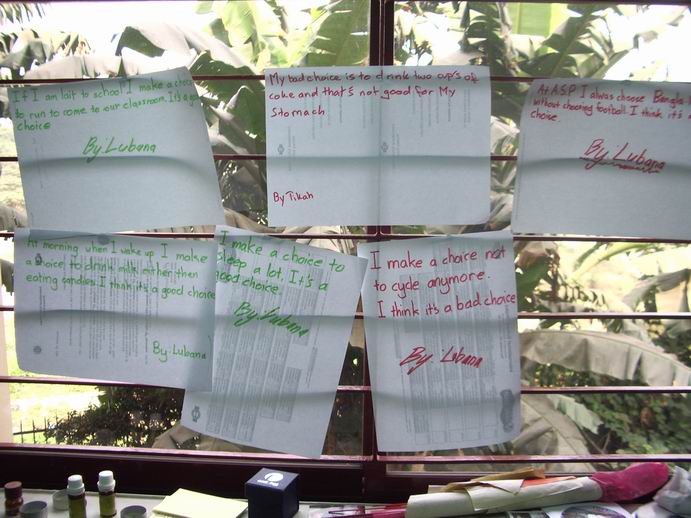
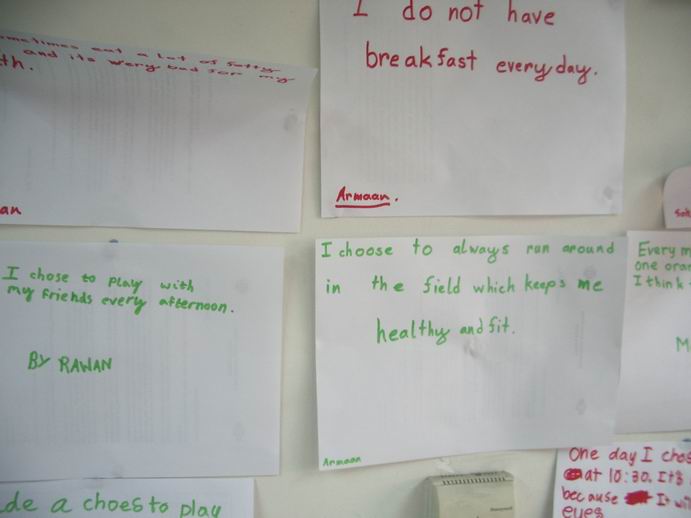
We thought about all the choices we make every day or every week of our lives, wrote them on pieces of scrap paper and then stuck them up all over the room - the walls are a mess! It made it really easy for us to start thinking about how our bodies are affected by those choices.

Saturday, January 21, 2006


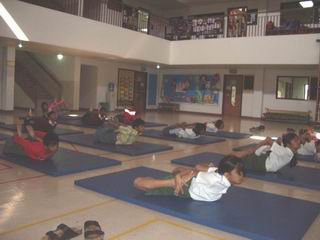
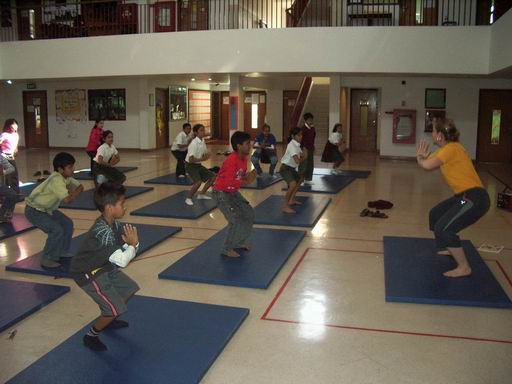
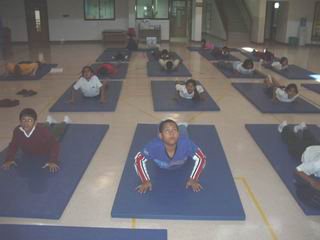
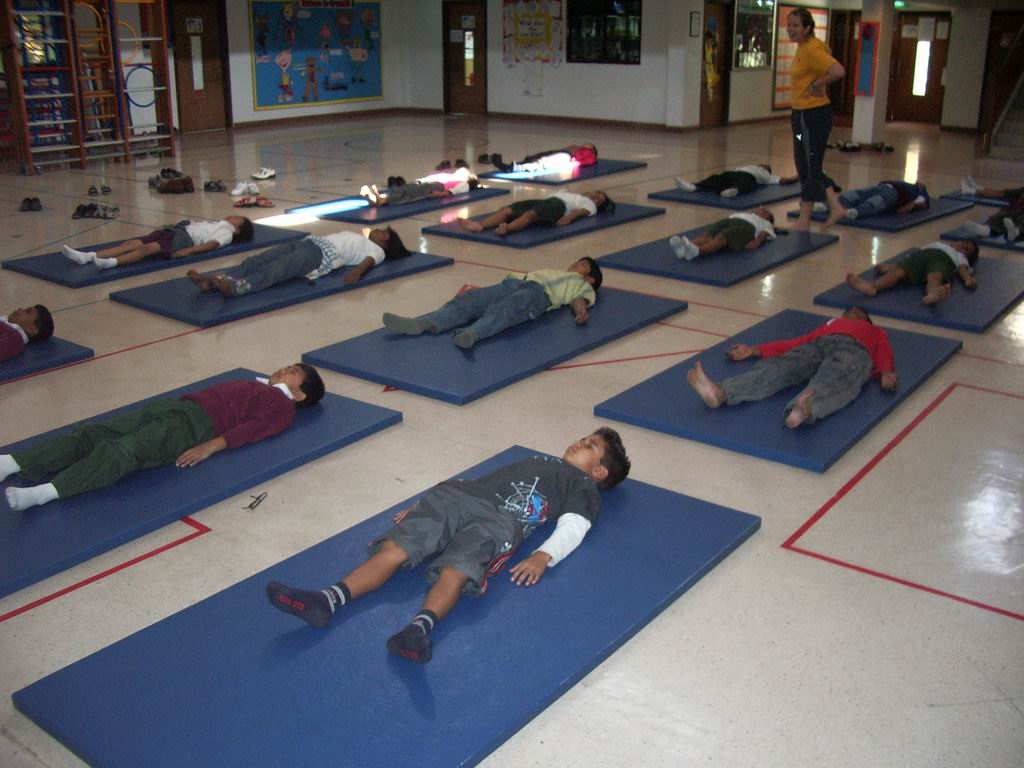
Yoga with Mrs. Fairbairn

To find out more about how certain activities affect our bodies, we did some yoga with a secondary teacher called Mrs. Fairbairn. Can you find out more information about yoga? Can you learn any new stances?
Choices, choices, choices...

The second teacher question in this Unit of Inquiry is "how is our body affected by our choices?". We have started our exploration of this question by thinking about the choices we make every day and deciding whether we think they are good or bad for our bodies. Here are some examples:

"I have made a choice to drink less coffee at work, and I hope that it will be good for my health." Mr. Sherratt

I make a choice to sleep only 5 hours,and that is bad for my health.
Henrica

My good choice is to sleep daily 8 hours
Afsana

My choice is to sleep at 8:30 thats good for me because I can get lots of rest
Farzad

My choice is to do my homework everyday i think thats good for my brain.
Afif

My choice is that I will drink milk and eat egg every single night and and morning.
Mysha

My choice is to play basketball everyday and I think its a good choice.
Meem
Monday, January 16, 2006


Experts teach their peers

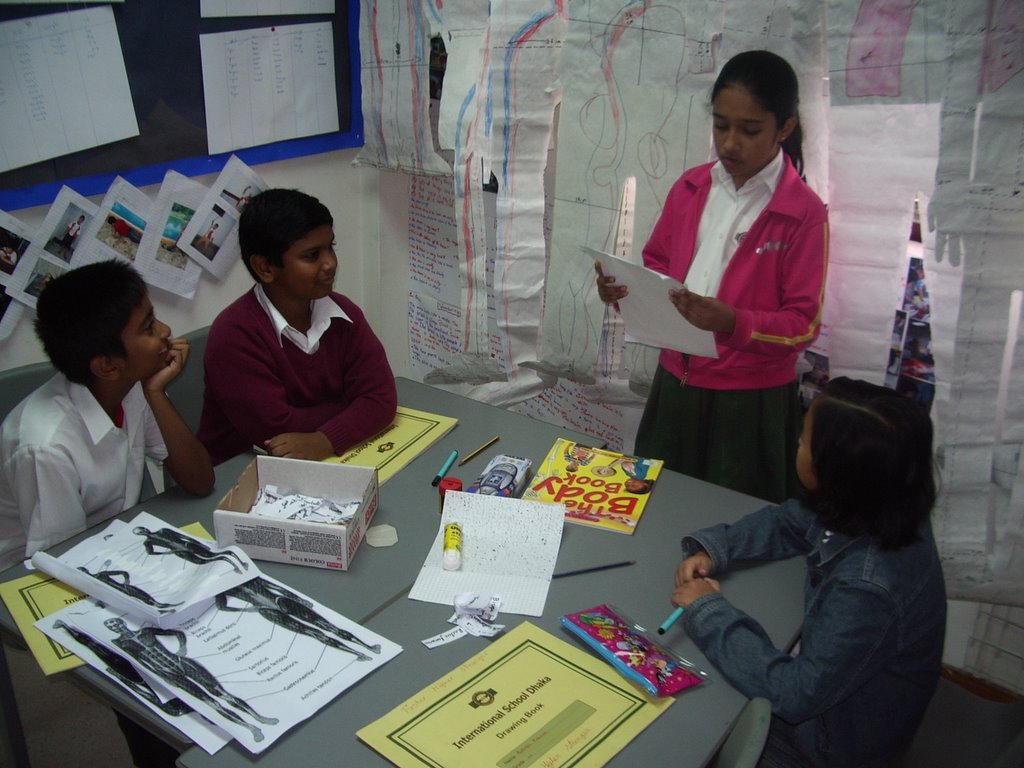
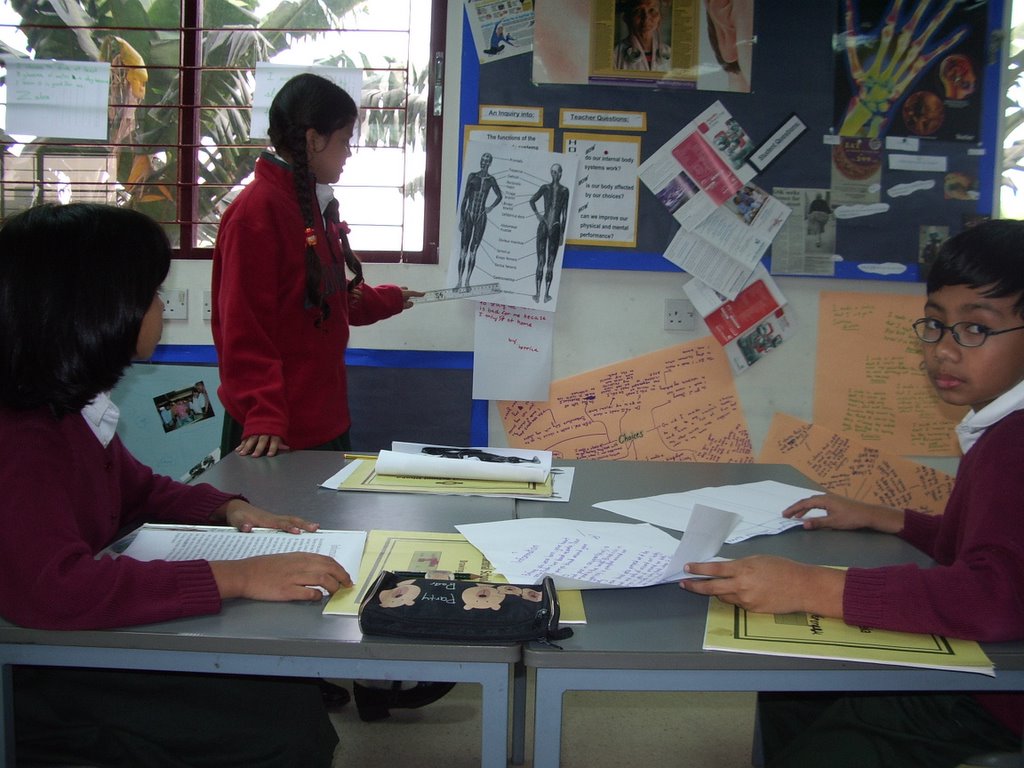
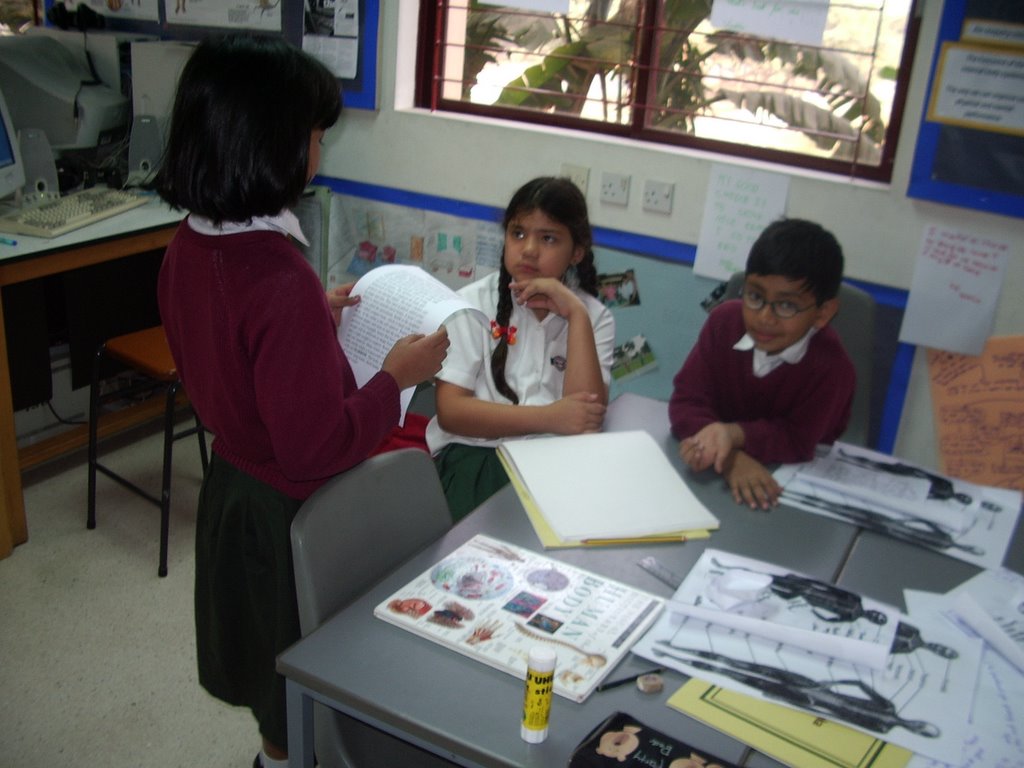
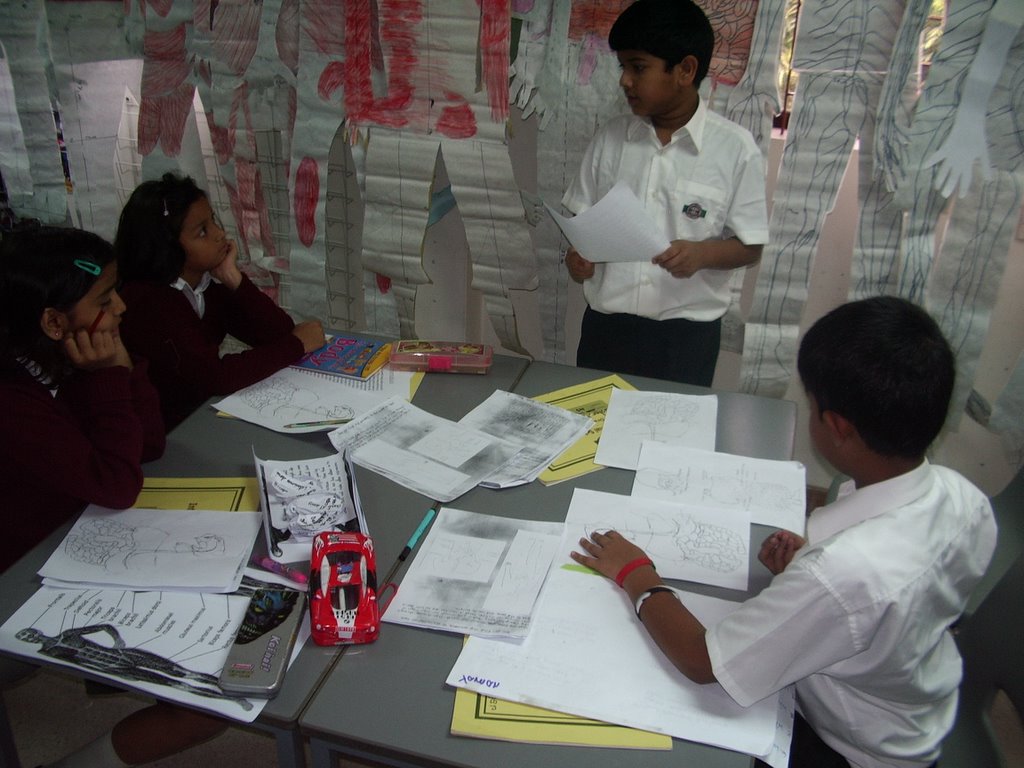
The experts on each of the body's systems spent several hours working together in small groups gathering information, preparing lesson ideas and materials and doing role-play lessons.

Today, they went back to their original table groups and taught each other about the systems our bodies are composed of. Here are some pictures, read the comments section to see how they thought it went.


Tuesday, December 13, 2005


Locating and Referencing Relevant Texts (what?????)

During this Unit of Inquiry, 4S will be learning how to show where they have got their information from. We will start doing this when they are finding information for the "jig-sawing" project in which they are learning about the main body systems. First, they will get in their expert groups and select books, chapters and chunks of text that they believe will help them in their project. They will then write the name of the book, the author, the date of publishing, the publisher and the relevant pages in their Unit of Inquiry books.

Monday, December 12, 2005

We have already found out that the Skeletal System is one of the systems in our bodies. Now, We're going to do some "jig-sawing" in order to learn what some of the other body systems are. In "jig-sawing" you teach other. To do this, you have been put into "expert goups' who will use the Internet and the books in our classroom to find out about one particular body system. You will then go back to your table group to teach them what you learned about.

Here are the expert groups:

Muscular System - Zahin, Verkha, Henrica, Meem
Skeletal System - Rushmila, Rhythma, Afsana, Ashfaq
Respiratory System - Armaan, Mahabubul, Afif, Moin
Nervous System - Rikitta, Yaman, Zaima, Mysha
Digestive System - Rawan, Saqlain, Lubana
Circulatory System - Zahra, Farzad, Farshed, Sohel

This is what you will need to research:

  1. Explain what your body system does for us.
  2. Name the parts of the system.
  3. Draw a diagram of the system.
  4. Draw a chart or diagram to explain how the system works.
Here's a good website to get you started, click on the name of your system when you hover the mouse over the bodies:

http://users.tpg.com.au/users/amcgann/body/


Monday, December 05, 2005


Real Animal Organs

To learn about the human brain, Grade 5 looked at some cow's brains. We thought that perhaps we could learn about the inside of our bodies by looking at the internal organs of an animal, as many of the parts are the same.

There are some video clips of the class looking at the animal organs on this link:
http://www.freewebs.com/sherrattdocs/4sdocuments.htm


Sunday, December 04, 2005

Next, we explored a CD-Rom called The Human Body. There are lots of diagrams, facts and quizzes on it. Here are some things that we found out:

A baby's brain size is a size of an apple.
Zahin

The heart is a strong muscle and an adult heart is the size of their fists.
Zaima

If someone drinks too much alcohol,they can damage their liver.
Mysha

A baby stays in it's mother's womb for 40 week's before it is born.
Moin

Our brain weighs 1.5 kg.
Farshed

Our bodies have 206 bones.
Rikitta

Our ear drums are just like a plate more than a web.
Sohel


Saturday, December 03, 2005


We started this Unit of Inquiry by making simple observations and asking questions about our own bodies. To do this, we sketched each other in various poses. Then we looked at the drawings that people did of us, and asked questions about ourselves. I'll use the picture on the left as an example:

Q. Are my legs really that short?
Q. Does my body really look like an 'm'?
Q. Are my eyes really just two black dots?
Q. Is my neck really that thin?


This activity does three main things for the students:

  1. They look at their own bodies in a critical and more scientific way
  2. It is a first step in learning about anatomical drawing
  3. It leads to interesting inquiry into the mathematics of our bodies (How many times do our heads fit into our bodies? How much bigger are our feet than our hands? How far apart are our eyes? What is the average length of our arms?)

Thursday, December 01, 2005


Organising Theme: Who We Are

Unit Title: Faster, higher, stronger

Focus: Science/ PE

Central Idea: Our bodies are complex systems and our choices affect our performance

An inquiry into:

  • The functions of the internal body systems
  • The way we can improve our physical and mental performance